 EN
EN

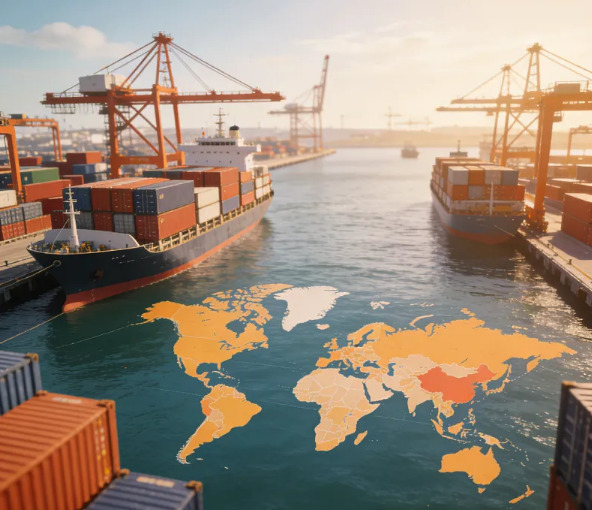
Speed isn't just about the plane
When a shipment needs to get from China to the USA as fast as possible, the instinct is to look at transit times and pick the shortest number. But door-to-door speed isn't just about how fast the cargo flies or sails. It's about the entire chain—pickup, export clearance, international transit, import customs, and final delivery. The fastest route on paper often isn't the fastest in practice if any link in that chain fails.
The China-USA trade lane handles enormous volumes daily. In 2025, U.S. imports from China declined by 29% compared with 2024, but the sheer scale of the corridor means multiple speed options exist for every cargo type and budget. Choosing the right one requires understanding not just the transit times but the tradeoffs that come with each.
Express courier: the undisputed speed champion
For parcels and small shipments under 200 kilograms, express courier services deliver the fastest door-to-door times available. DHL Express Worldwide, FedEx International Priority, and UPS Worldwide Express typically move shipments from China to major U.S. cities in 2 to 7 days.
FedEx International Priority consistently hits 2 to 3 days for major routes, while DHL Express Worldwide runs 3 to 5 days. The key advantage isn't just the flight time—it's the integrated clearance. Express carriers handle customs electronically and in parallel with transit, so shipments arriving at U.S. hubs are often already cleared.
The catch? Cost. Express rates run $5 to $10 per kilogram and are best suited for high-value, time-critical items like prototypes, medical samples, or urgent replacement parts. For heavier shipments, the per-kilo cost becomes prohibitive.
Air freight: the fastest option for larger cargo
Once shipments exceed 200 kilograms, air freight becomes the fastest practical option. Door-to-door transit typically runs 5 to 10 days, with the actual flight time from Shanghai, Hong Kong, or Guangzhou to Los Angeles, Chicago, or New York taking just 12 to 16 hours.
The remaining time goes to export pickup and consolidation, U.S. customs clearance, and final inland delivery. Air freight rates range from $3.50 to $7 per kilogram, with chargeable weight calculated as the higher of actual and volumetric weight.
A New York-based electronics distributor needed to restock a popular item that had sold out faster than expected. Standard ocean freight would have taken over 30 days—too long to capture the remaining holiday sales window. Air freight delivered the goods in six days door-to-door. The higher freight cost was more than offset by the additional sales revenue captured during that peak period.
| Shipping Method | Door-to-Door Time | Weight Range | Cost per kg | Best For |
|---|---|---|---|---|
| Express Courier | 2-7 days | Under 200 kg | $5-10 | Samples, prototypes, urgent small parcels |
| Air Freight | 5-10 days | 100 kg to several tonnes | $3.50-7 | Commercial cargo, time-sensitive inventory |
| Sea/Air Hybrid | 10-15 days | Pallets, mid-volume | $2-4 | Balance of speed and cost |
| Ocean FCL (West Coast) | 18-30 days | Full container | Lowest per unit | Bulk cargo, non-urgent |
| Ocean FCL (East Coast) | 30-45 days | Full container | Lowest per unit | Bulk cargo, non-urgent |
The hybrid alternative: sea/air for mid-range speed
For shipments that need to move faster than ocean freight but don't justify the full cost of air, sea/air hybrid services offer a compelling middle ground. Cargo moves by vessel from China to a transshipment hub—typically in the Middle East—then flies the rest of the way to the U.S. Door-to-door times run 10 to 15 days at roughly half the cost of pure air freight.
This option works well for mid-volume shipments on pallets that are too large for express but not urgent enough to justify full air freight rates. The tradeoff is less predictability—transshipment schedules can introduce variability that direct air or ocean services don't have.
What slows down "fast" shipments
The fastest shipping method on paper can still deliver slowly if other factors intervene. Customs clearance is the biggest wildcard. Even with air freight's 12 to 16 hours of flight time, a shipment held in customs for three days isn't fast anymore.
Proper documentation is non-negotiable. Missing or incorrect commercial invoices, packing lists, or HS code classifications trigger inspections that add days or weeks to clearance. Express couriers mitigate this with electronic pre-clearance, but air freight shipments require accurate paperwork submitted before the cargo arrives.
A freight forwarder in Guangzhou recalled a shipment of consumer electronics that was booked on a premium express service with a promised 3-day delivery. The cargo arrived in the U.S. on time but sat in customs for five additional days because the HS code didn't match the product description. The "fastest" service ended up taking eight days—slower than standard air freight would have been with correct documentation.
Choosing speed wisely
Fastest doesn't always mean best. The decision comes down to cargo value, urgency, and budget. Express courier wins on speed for small packages but costs a premium. Air freight scales better for larger shipments but requires meticulous documentation to avoid customs delays. Sea/air hybrid offers a balanced compromise for mid-sized cargo. Ocean freight is the slowest but cheapest, suitable when time isn't the primary constraint.
For shipments that truly can't wait, the fastest door-to-door route is express courier with electronic customs pre-clearance—typically 2 to 3 days for major city pairs. For larger commercial cargo, air freight with properly pre-cleared documentation consistently delivers in 5 to 7 days. Anything beyond that is a tradeoff between cost and speed that each shipper must evaluate on its own merits.
Companies like Bingo International handle door-to-door shipping across all these modes, with the operational experience to match the right speed option to each shipment's requirements. Their work across e-commerce, manufacturing, and retail sectors shows that the fastest route isn't always the most expensive—it's the one that gets the cargo to the right place at the right time without unnecessary delays.